What is a Monorail?
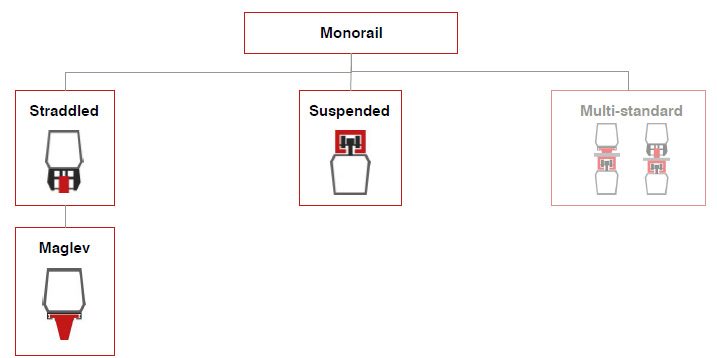
A monorail is a transport system that travels either on (classic or straddle monorail) or under (suspension monorail) a single narrow track or, better, a guide beam. The beam can take on different shapes and be made of different materials, it is designed as one structural element. The monorail guide beam consists of a single structural rail, in most cases taking both loads, the capacity (vertical) load and the guidance (lateral) load. Monorails are usually driven by onboard electric motors. The types commonly referred to the term monorail can thus be classified according to their carrying and guiding principle and vehicle placement.
Monorails have been around for more than a century; however, only recent developments have enabled transport authorities to consider monorails as a real alternative in public transportation to meet their needs in mass urban transit. Monorails are often easier to integrate into existing urban areas as they are comparatively easy to build elevated, taking up little valuable traffic space at the street level and requiring no expensive tunnelling. The special track design of monorails generally supports a cost-effective, elevated construction method and a very fast implementation. Despite a significantly increasing numbers of applications, monorail systems still maintain a niche existence.
Nevertheless, different monorail systems have established themselves over time.
Suspended Monorails
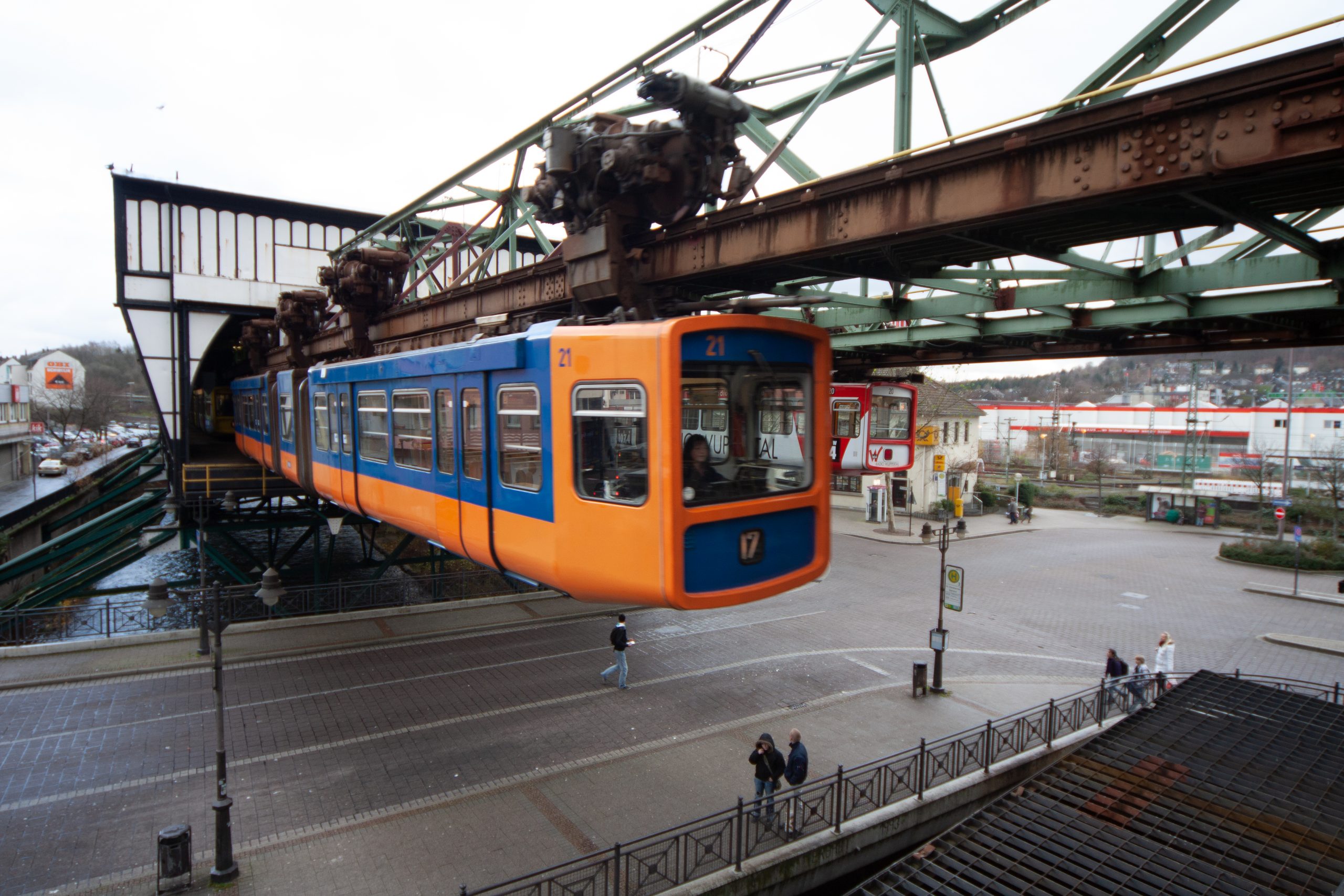
In addition to the first suspended monorails (such as the Wuppertal suspension railway), where steel wheels with flanges on both sides carry the vehicle and guide it on the steel rails, suspended railways are also designed with guideway girders consisting of a slotted hollow steel profile. Two vertical wheels to the left and right of the slot carry the vehicle, and horizontal rollers guide the vehicle on the vertical inner flank of the profile on both sides. The edge length of the hollow profile can be up to 2 m.
Nevertheless, there exist many rubber tired suspended monorail systems running on the inner side of the hollow beam, as well guided on the same beam on the inside side walls.
Straddled Monorails
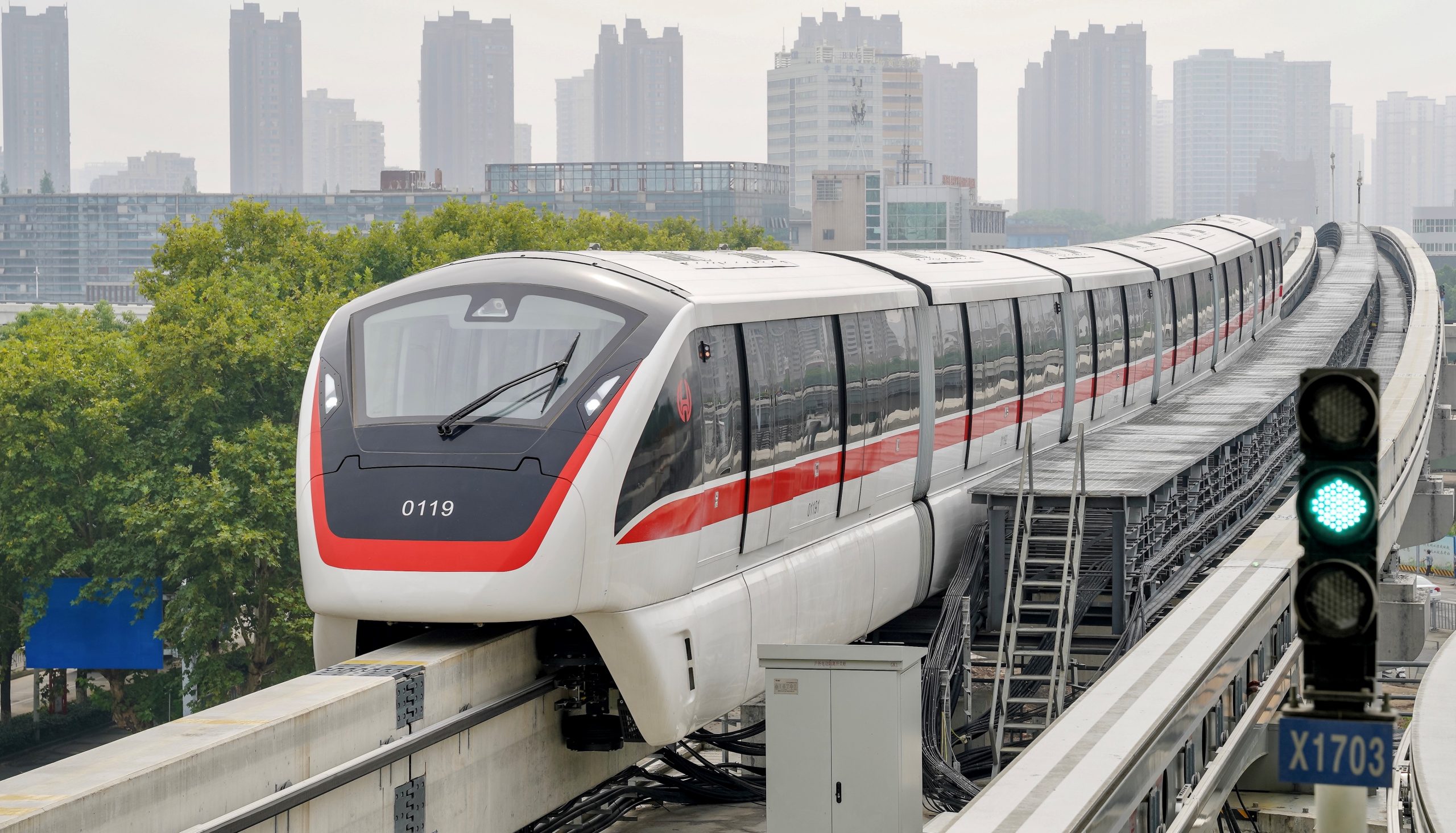
The most widespread type of monorails is the so-called straddled monorail. Many of the straddled monorail systems are based on the Alweg system from 1952, where the vehicle embraces both sides like a saddle around the track, which is formed from a narrow concrete beam with a rectangular cross-section. Depending on the system, the guide beam width varies between 500 and 900 mm and the height typically between 1 and 2 m.
The vehicle’s load wheels are supported by the beam. Due to the small support width of the carrying wheels, guide rollers are arranged on both sides in two vertically superimposed areas in order that the vehicle is held upright and guided along the track. Straddled monorails with a narrow guideway beam are available in high-floor and low-floor versions. The latter require central wheel housings inside the vehicle for the load wheels.
Furthermore, some monorails are designed with wider guideway beams, with laterally protruding flanges. Their width already provides a sufficient support base for the load wheels. In addition, guide wheels grip the flange from below so that guide rollers on both sides are only required in one area.
Maglev
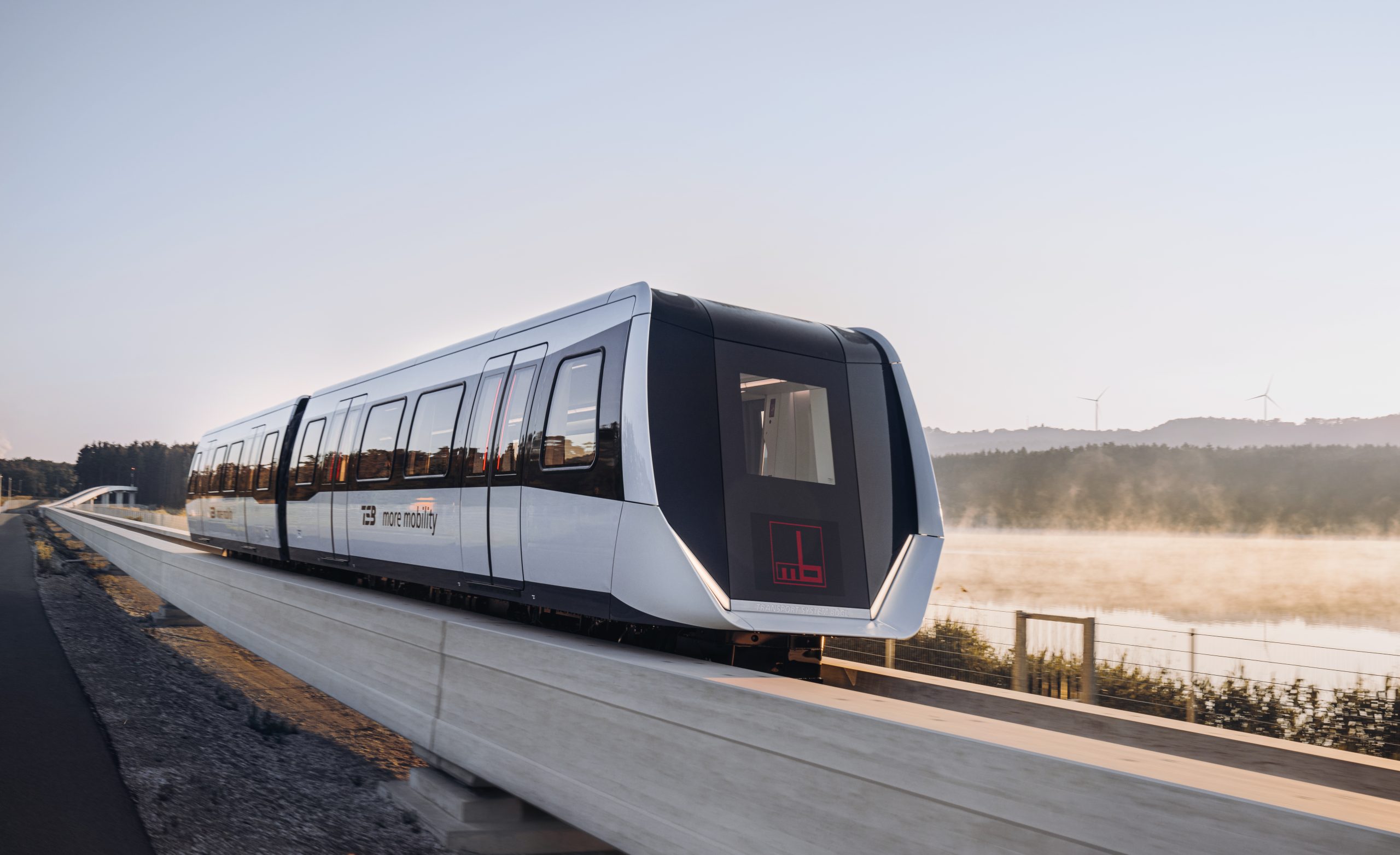
Maglevs (from magnetic levitation) are track-guided land transportation vehicles that are levitated, track-guided, propelled, and braked by magnetic forces. Since most maglev systems embrace the track on both sides like straddled monorails, maglev systems are classified as monorails and can be considered as a sub-group of straddled monorails
Further system approaches
Beyond the above-mentioned types of system, there are other technologies that have not yet found their way into revenue service. For example, some concepts such as the multi-standard monorail, where the running beam is to be used for both straddled and suspended tracks – i.e., a parallel combination of suspended and straddled monorail. There are as well ideas for so-called cantilevered monorails, in which the lateral surfaces of the guideway beam are used to support two laterally guided monorails.